Higher fouling resistance
The open module structure supports easier cleaning and less pressure drop across the membrane system.
Our technologies
ROTREAT uses radial channel disc tube modules for feed waters where standard spiral wound systems often reach their operational limits.
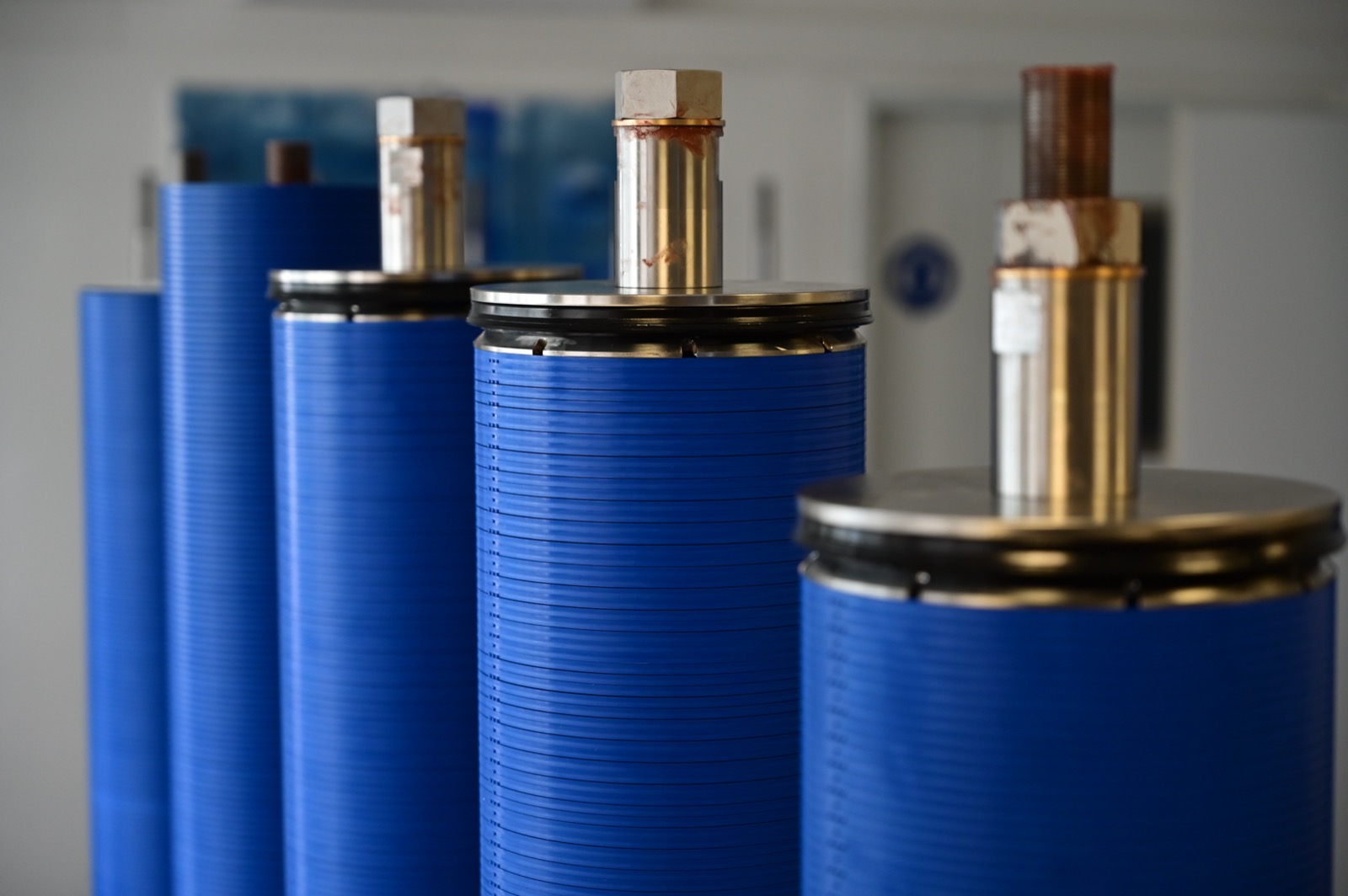
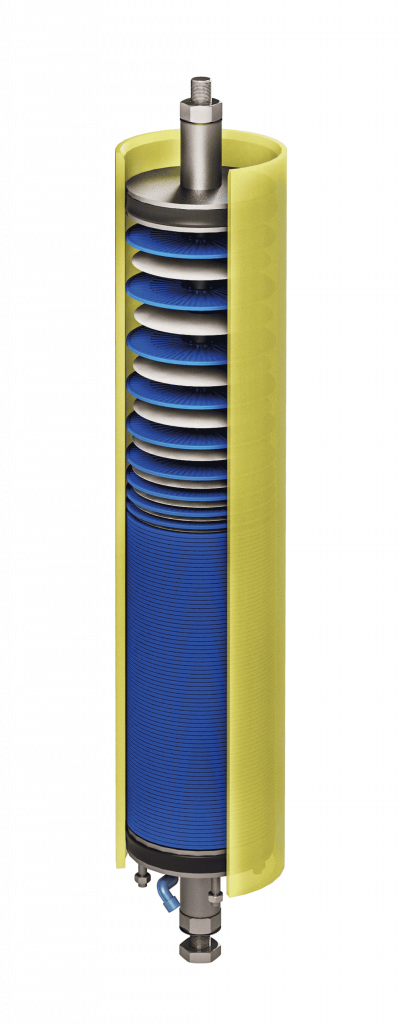
RCDT module design
The RCDT module consists of a pressure tube and hydraulic discs which are held by a centre tension rod. Round membrane cushions lie between every two discs. The membrane cushions are made of two single membranes sealed by ultrasonic welding, separated by a fleece tissue spacer.
Owing to this special construction, open flow channels are formed between the hydraulic discs and the membrane cushions where the raw solution concentrates. The individual channels are joined together by openings in the discs, arranged in an annular pattern. The feed water flows radially across the membrane cushions, alternately from the inside towards the outside and reversibly.
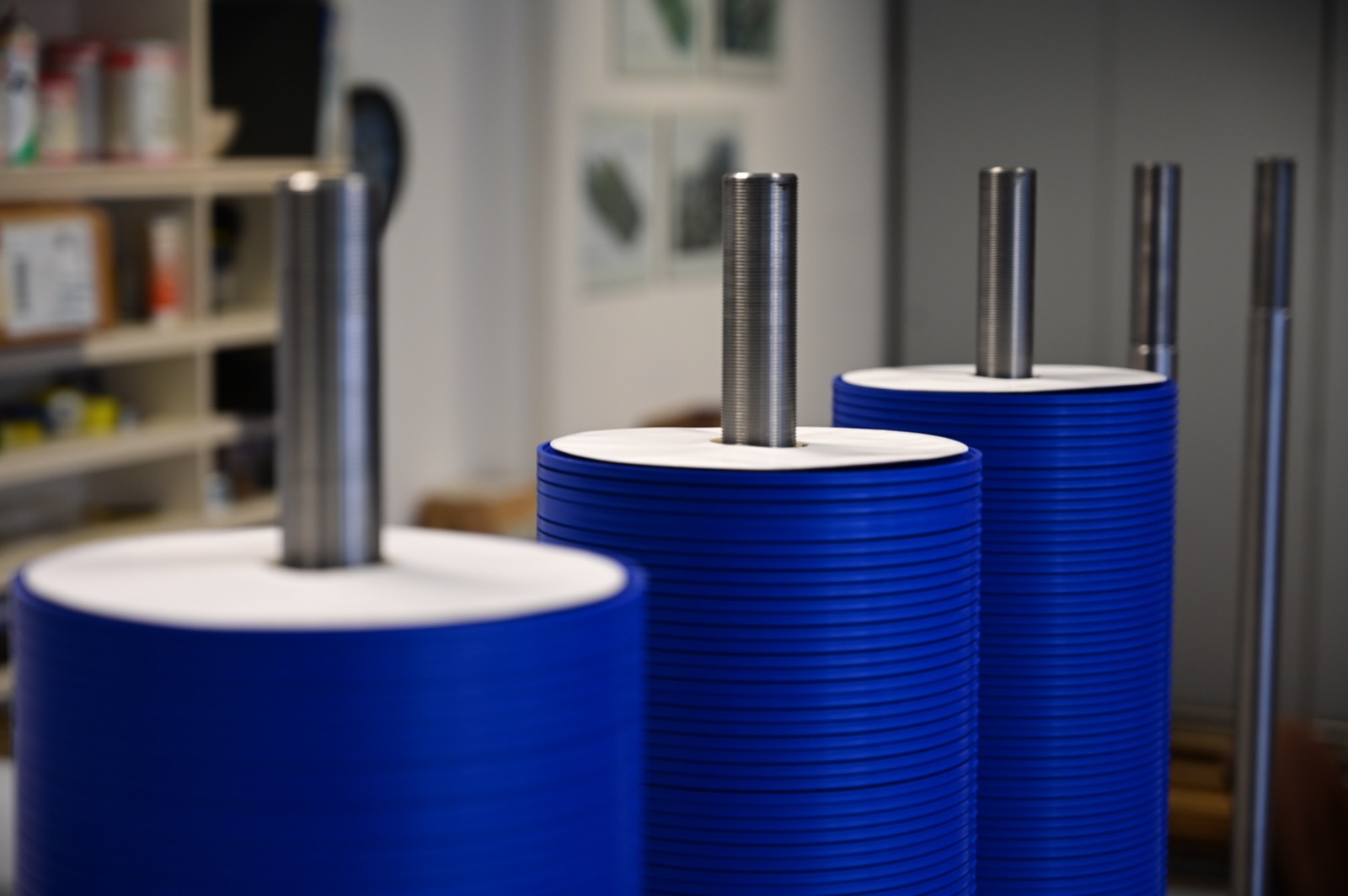
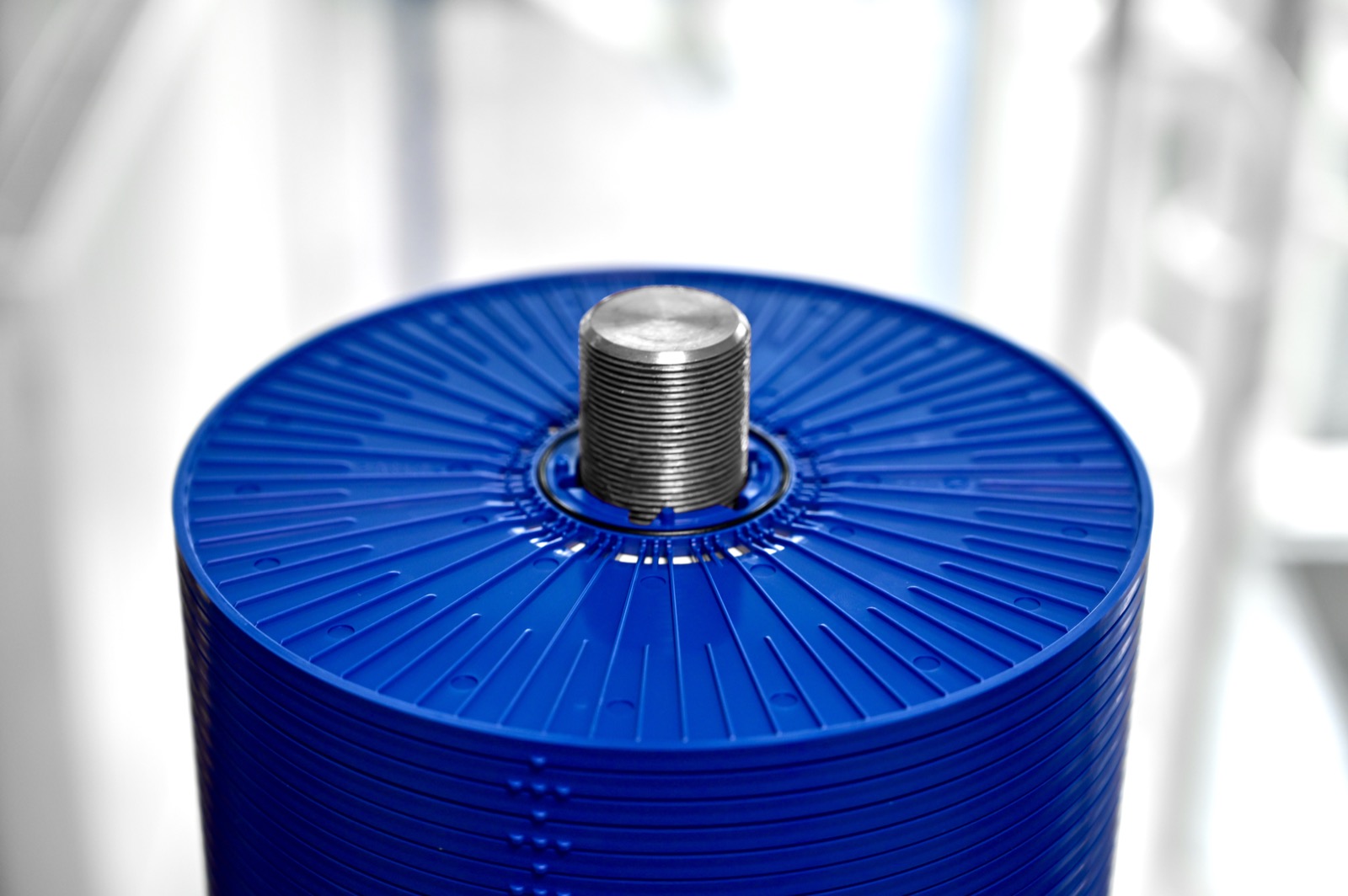
The permeate that has been separated by the membrane flows on the inside of the cushion into the spacer, radially inwards to the central permeate sewer, and is directed along the tension rod pin to the connecting flange of the module. The separation of concentrate and permeate happens between the hydraulic disc and the membrane cushion.
All membranes are manufactured in our own membrane production. This way we can guarantee the highest quality standard and a very short delivery time. The membrane cushions are made of two composite membrane discs with an intermediate layer. The membranes are manufactured from modified polyamide, while the intermediate layers are made from polyester.
Using ultrasonic welding, the medium can only come into contact with the active membrane layer. Besides various reverse osmosis membranes, the RCDT module is also available for nanofiltration membranes.
Latest generation
The newest disc generation is RCDT 3.0. It is characterized by even more membrane area per module than the previous RCDT 2.0 generation, supporting compact plant layouts and efficient module design.
The offered plant is using the so called RCDT module technology. Through the use of the open feed channel design, this technology has a high tolerance against potential scaling and fouling compounds compared with spiral wound technology.
The open channel design further allows the mechanical and chemical effort for raw water adjustment to be reduced to a minimum. In seawater applications, the need for chemical dosing can be eliminated with this technology.
Operational advantages
Information from the ROTREAT product catalog highlights the practical advantages of RCDT modules over compact spiral wound arrangements in difficult industrial applications.
The open module structure supports easier cleaning and less pressure drop across the membrane system.
Accessible flow channels support efficient clean-in-place procedures and practical long-term operation.
RCDT modules are suitable where feed water has high turbidity, solids or other contaminants.
Technical data
The detailed datasheet for RCDT 2.0 and RCDT 3.0 modules is available as a PDF download. It can be expanded into a table on this page later if required.
FAQ
RCDT uses open radial flow channels and disc tube modules, which can be more service-friendly and tolerant of difficult wastewater than compact spiral wound elements.
RCDT is useful for landfill leachate, industrial wastewater, concentrate streams and other applications where fouling, scaling and variable feed quality must be managed.
More ROTREAT topics